
Back pain is one of the most common reasons patients seek medical care, yet choosing the right treatment can feel overwhelming. Many patients are told surgery is their only option—but that isn’t always the case.
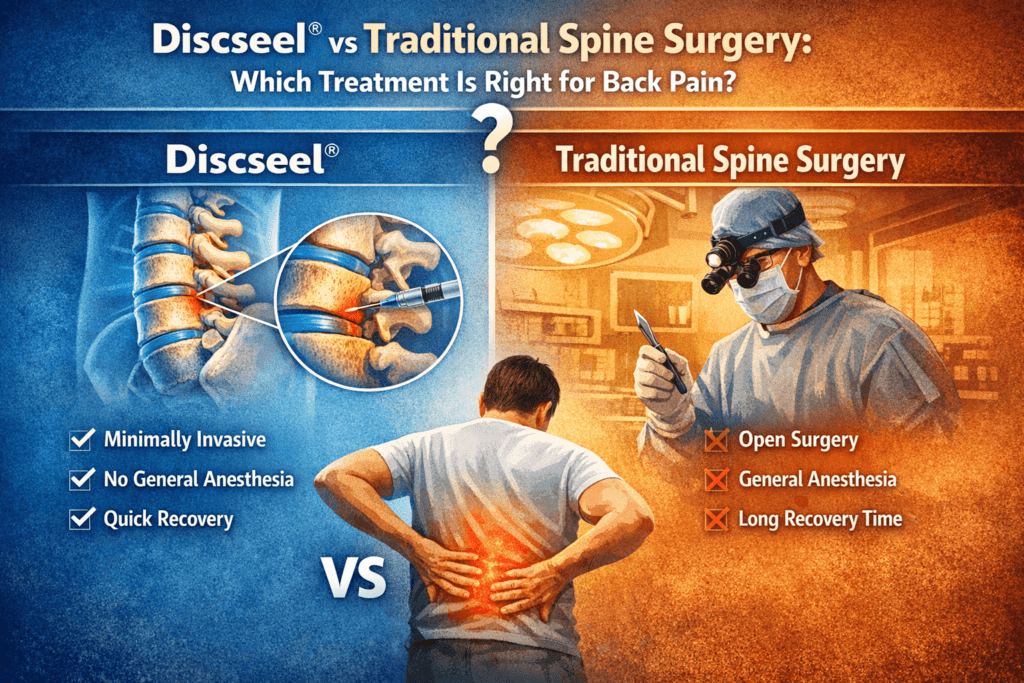
For certain types of disc-related pain, Discseel® offers a minimally invasive alternative to traditional spine surgery. Understanding the differences between these approaches can help you make a more informed decision about your care.
What Is Discseel®? (Minimally Invasive Treatment for Annular Tears)
Discseel® is a non-surgical, injection-based procedure designed to treat annular tears—small tears in the outer layer of spinal discs that can cause chronic back pain.
Unlike traditional surgery, Discseel® focuses on preserving the natural disc rather than removing or altering spinal structures.
Key Benefits of Discseel®
Minimally invasive (no large incision)
Targets the root cause of disc pain (annular tears)
Outpatient procedure
Shorter recovery time compared to surgery
Preserves normal spine anatomy
Discseel® may be an option for patients experiencing:
Chronic low back pain
Disc-related pain not improving with therapy or injections
MRI evidence of annular tears
Pain without severe nerve compression
What Is Traditional Spine Surgery?
Traditional spine surgery includes procedures such as:
Discectomy
Laminectomy
Spinal fusion
These procedures are typically recommended for advanced or structural spine conditions, especially when there is significant nerve compression or instability.
When Spine Surgery May Be Necessary
Severe spinal stenosis
Large disc herniations compressing nerves
Progressive weakness or neurologic deficits
Spinal instability or deformity
Failure of conservative and minimally invasive treatments
While many modern spine surgeries use minimally invasive techniques, they still involve altering spinal anatomy and generally require longer recovery times.
One of the most important distinctions is this:
Discseel® is designed for disc-related pain, while spine surgery is typically reserved for advanced structural conditions.
Many patients with chronic back pain are found to have annular tears, which may not require surgery. In these cases, Discseel® can provide a treatment option before considering more invasive procedures.
However, not every patient is a candidate.
How to Know If You’re a Candidate for Discseel®
Determining the right treatment starts with a comprehensive evaluation, including:
Detailed history and physical exam
MRI review of the spine
Identification of the true pain generator
You may be a candidate for Discseel® if:
Your pain is disc-related (not primarily from severe nerve compression)
MRI shows annular tears or disc pathology
You have not improved with conservative care
You want to avoid or delay surgery
You may need surgical evaluation if:
There is significant nerve compression
You have weakness, numbness, or progressive symptoms
Imaging shows advanced spinal instability
Why Proper Diagnosis Matters
Back pain is complex, and not all pain originates from the same structure. Misdiagnosis can lead to unnecessary procedures—or missed opportunities for less invasive treatment.
The goal is not just to treat symptoms, but to:
Identify the exact source of pain
Match the treatment to the diagnosis
Avoid unnecessary surgery when possible
Discseel® in Dallas / North Texas
At DFW Sports Medicine, we specialize in advanced, minimally invasive spine treatments, including Discseel® for appropriate candidates.
Our approach focuses on:
Precise diagnosis using imaging and clinical evaluation
Personalized treatment plans
Avoiding unnecessary surgery whenever possible
Final Thoughts: Discseel® vs Surgery
Discseel® and traditional spine surgery serve very different roles in treating back pain.
Discseel® ? Best suited for disc-related pain such as annular tears
Spine surgery ? Reserved for structural or advanced spine conditions
The key is choosing the right treatment for the right diagnosis.
Take the Next Step
If you’re dealing with chronic back pain and want to explore your options:
Get your MRI reviewed
Understand the source of your pain
Learn whether you may be a candidate for Discseel®
Early evaluation can help you avoid unnecessary procedures and get back to doing what you love.