
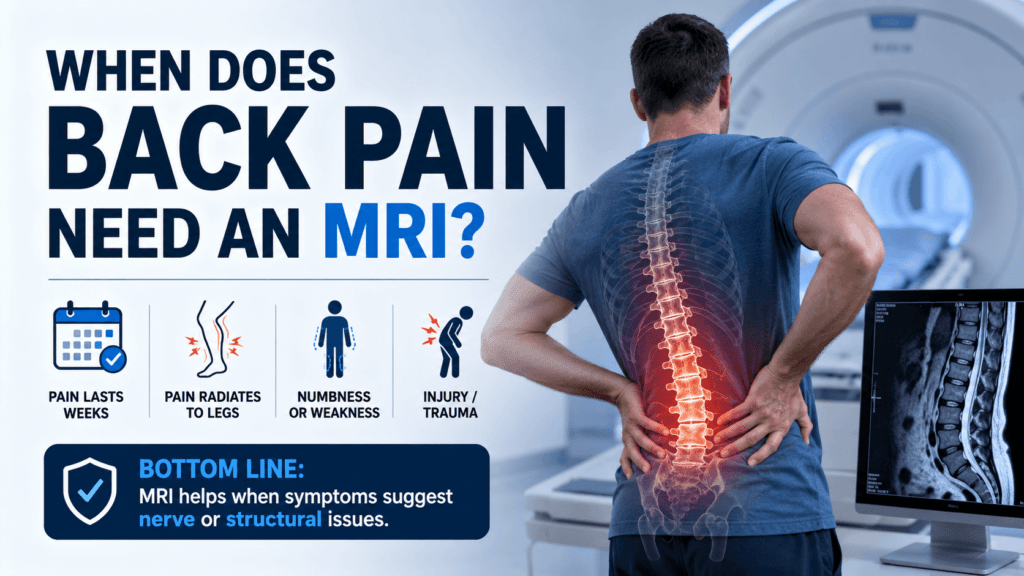
Back pain is one of the most common reasons people visit a doctor, but not every case requires advanced imaging. In fact, most episodes of back pain improve with time, activity modification, physical therapy, and conservative treatment.
However, there are situations where an MRI becomes important to evaluate for nerve compression, disc injuries, or other structural problems.
When an MRI May Be Recommended
Your physician may consider ordering an MRI if you experience:
- Back pain lasting several weeks despite treatment
- Pain radiating into the legs (sciatica)
- Numbness or tingling
- Muscle weakness
- Difficulty walking or balance issues
- Significant injury or trauma
- Persistent pain affecting daily function
MRI scans provide detailed images of discs, nerves, spinal joints, and soft tissues that cannot be seen on standard X-rays.
What an MRI Can Detect
An MRI may help identify:
- Herniated or bulging discs
- Spinal stenosis
- Pinched nerves
- Degenerative disc disease
- Stress injuries or fractures
- Inflammation or structural abnormalities
When Imaging May Not Be Needed
For many patients with mild or recent back pain, imaging is often unnecessary early on. Studies show that routine MRIs without concerning symptoms do not always improve outcomes and can sometimes lead to unnecessary treatments.
Treatment Options if an MRI Finds a Problem
If an MRI does pinpoint a clear cause, the next step is matching treatment to the diagnosis. DFW Sports Medicine offers several minimally invasive spine procedures for exactly these findings, including the DISCSEEL® Procedure for annular disc tears and degenerative disc disease, the MILD® Procedure for lumbar spinal stenosis, Kyphoplasty and Vertebroplasty for spinal compression fractures, and Spinal Cord Stimulation or Peripheral Nerve Stimulation for chronic, radiating nerve pain. The right option depends on your imaging results and a full clinical evaluation, so talk with your provider about which approach fits your condition.
Bottom Line
Most back pain improves without advanced imaging, but persistent pain, radiating symptoms, weakness, or trauma may require an MRI to evaluate for nerve or structural issues and guide treatment.