
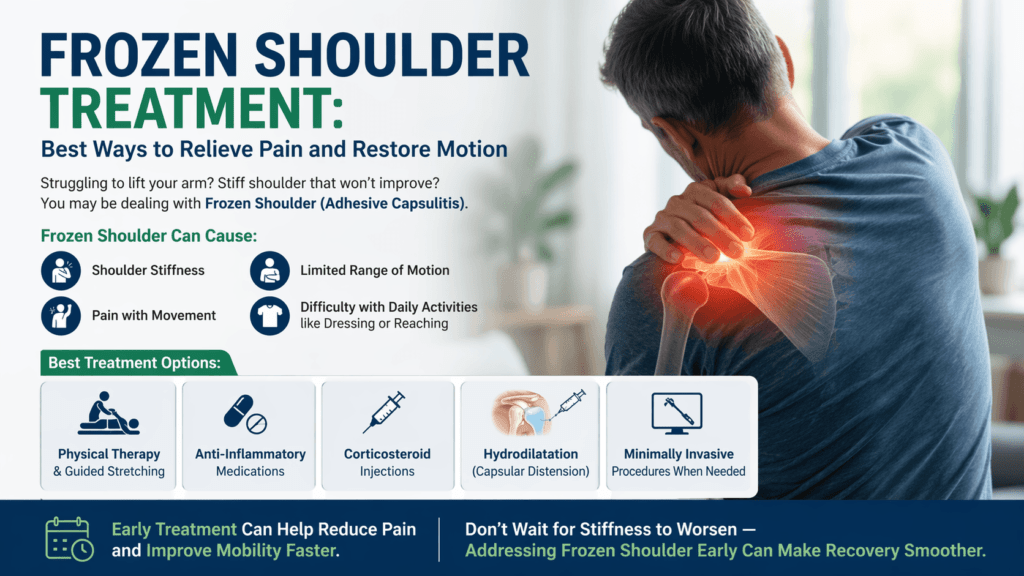
Struggling to lift your arm? Noticing a stiff shoulder that just won’t improve?
You may be dealing with frozen shoulder (adhesive capsulitis) — a condition that develops gradually and can significantly limit your daily activities.
What is Frozen Shoulder?
Frozen shoulder occurs when the connective tissue surrounding the shoulder joint becomes thickened and inflamed, leading to pain and restricted movement.
It typically progresses through three stages:
Freezing stage: Increasing pain and stiffness
Frozen stage: Stiffness persists, pain may improve
Thawing stage: Gradual return of motion
Common Symptoms
Shoulder stiffness
Pain with movement
Limited range of motion
Difficulty with everyday activities (dressing, reaching overhead, sleeping)
Best Treatment Options
Treatment focuses on relieving pain and restoring mobility. Most patients improve with non-surgical care.
1. Physical Therapy
Targeted stretching and strengthening exercises are the foundation of treatment.
Consistency is key to regaining motion.
2. Anti-Inflammatory Medications
Over-the-counter or prescription medications can help reduce pain and inflammation.
3. Corticosteroid Injections
Image-guided injections can:
Reduce inflammation
Improve pain
Allow more effective participation in therapy
4. Hydrodilatation (Capsular Distension)
A minimally invasive procedure where fluid is injected into the joint capsule to:
Stretch the capsule
Improve mobility
Reduce stiffness
5. Minimally Invasive Procedures
For patients who do not improve with conservative care:
Manipulation under anesthesia
Arthroscopic capsular release
These options are typically reserved for persistent or severe cases.
Why Early Treatment Matters
Addressing frozen shoulder early can:
Shorten recovery time
Prevent worsening stiffness
Improve overall outcomes
Waiting too long can prolong symptoms and delay recovery.
When to See a Specialist
If your shoulder pain and stiffness:
Persist beyond a few weeks
Limit daily function
Do not improve with basic measures
…it’s time for a professional evaluation.
Takeaway
Frozen shoulder can be frustrating, but effective treatments are available. With the right combination of therapy and targeted interventions, most patients regain function and return to normal activities.